Menu
We take a dive into comparing Adpulse to Optmyzr to help you choose which one is better suited to your agency
Start a free 14-day trial during March and only pay $19.99 USD for the first month.
Unlimited spend, unlimited ad accounts, unlimited users, unlimited potential.


When managing multiple accounts (or being a part of a team that manages multiple accounts), having instant visibility across the budgets and performance of those accounts and teams is crucial. It provides direction to prioritize work based on account performance across a portfolio of accounts, removes a significant amount of time spent on analysis, and provides those on the tools with a focused approach to their day.
Optmyzr, like many of the platforms we’ve reviewed, has a dashboard that lists the imported ad accounts, and provides topline metrics for a given time period. Alongside this is Optmyzr’s Audit Score, which uses a report card type system where the account is assigned a letter based on the outcome of the audit, with A being the best (no audit was provided for my Facebook test account tho’ and upon further investigation it appears the full suite of tools is not available for Facebook).
Out of interest, we compared the TrueClicks, Adalysis, and Optmyzr scores for two randomly chosen accounts to see how they would differ – it demonstrates quite clearly how differently each platform measures ‘success’.
There is a ‘Dashboard’, but that is a deep view into a single Ad Account so not helpful when trying to work out which accounts most need attention when you start your week.
Everything in Optmyzr is built around the analysis of a single account – there is no overview of a portfolio of accounts, no at-a-glance visibility into which budgets are under or over-pacing, and no ability to segment the data by a person, team, or vertical for example. This makes team management harder, plus, as there is no data-driven prioritization, the team on the tools would need to review each account individually before knowing which ones most need attention, which is not the best use of their time.
Adpulse’s Dashboard is more focused on being able to review portfolios of clients at a glance to instantly identify which are not performing to expectation and/or not budget pacing correctly, and therefore where the manager’s effort should be focussed. This provides instant insight into the performance of client segments, teams, or even specific team members and clients. It removes the hunt for ‘where to start’ and promotes a team that spends its time where it’s needed most.


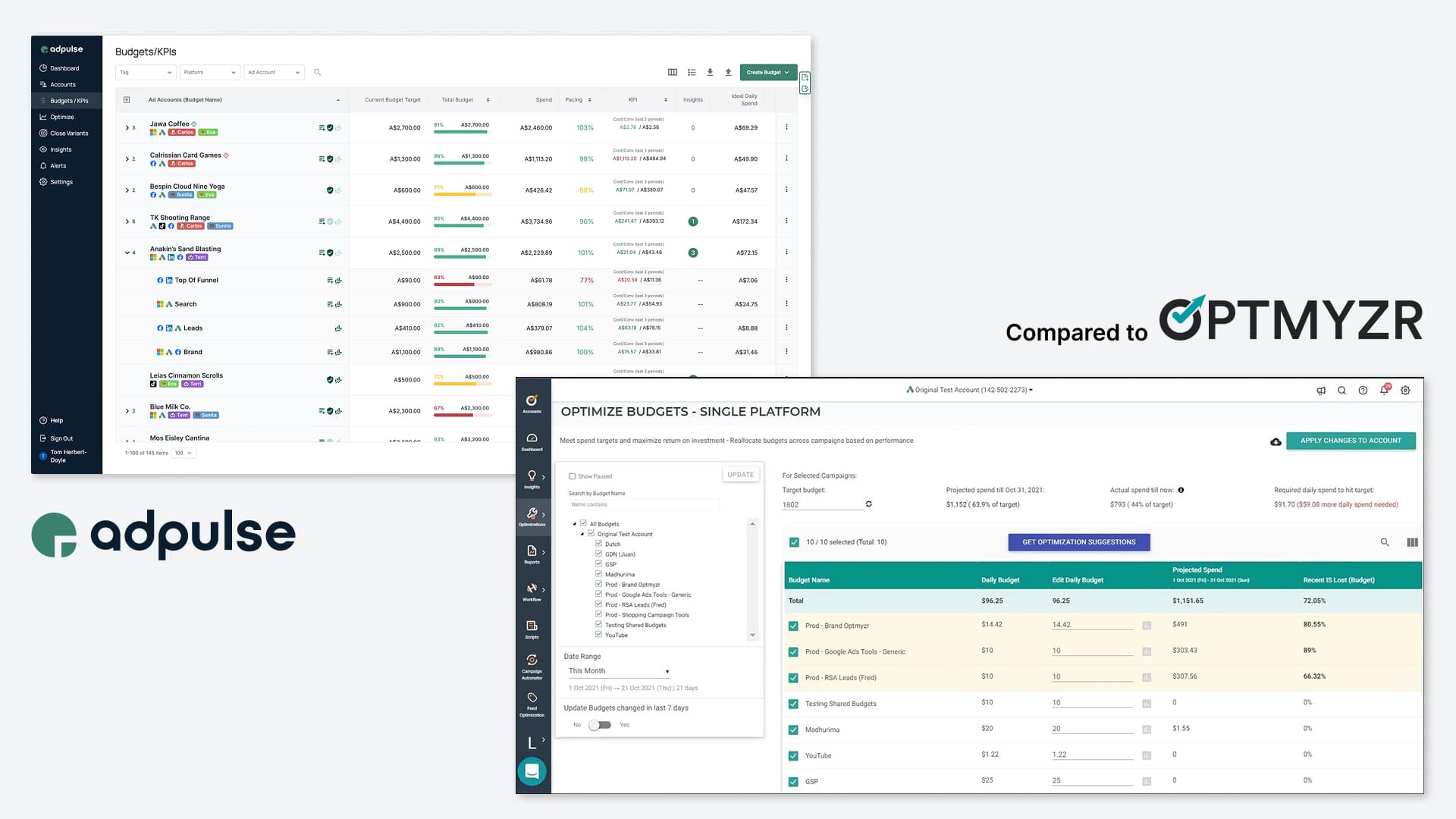
Maximizing PPC budgets is a cornerstone of PPC management and most of the similar platforms have an offering here. The difference is how advanced it is and what value it provides the agency – is it just a reporting view or can it take action automatically?
Budget Alerts are critical to avoid potentially costly overspending on client accounts, or to be alerted when the campaigns are not spending and pacing has dropped below a certain threshold. This is the stuff that can ruin a client relationship, so accurate and timely checks/alerts are crucial.
Optmyzr has a couple of budget management tools; Spend Projection, and budget alerts, plus a couple of scripts you can add to an account. The Spend Projection is a stand-alone tool and is similar to budget pacing where it’ll project your spend for the period and, when you enter a target, how close you’ll get to this. It only works at the Ad Account level tho’, so no ability to create custom cross-platform budgets, for example; group Top of Funnel campaigns across Facebook and Google with a single budget and KPI (like you can do in Adpulse and Shape.io).
The budget monitors are a little more flexible and you can create cross-platform spend and pacing alerts. You can also create alerts at the campaign level, which is great (just wish the UI told me which campaigns were paused).
To automatically pause campaigns when a budget spend threshold is reached, Optmyzr requires you to install a separate script for each account, whereas in Adpulse (AutoProtect) and Shape.io (AutoPilot) you can do this natively within the UI.
So, the Optmyzr budget functionality is similar to Adpulse, but it uses a combination of separate tools and scripts to achieve the same functionality that you get in one place with Adpulse and Shape.io.


Managing spend is great, but that is only a part of successfully managing PPC accounts. Identifying and actioning optimizations is often the bulk of the time spent when working on a PPC account, so making the best use of your time is critical (aka reducing the amount of time creating and analyzing pivot tables)
Optmyzr has so much data it’s almost a little overwhelming, and I’m not quite sure where to start. I found their ‘Express Optimizations’ a good place to begin as it collates all of the suggested optimizations in one place for all your accounts – this is the only place I found that offers a ‘portfolio view’ of your accounts. It’s a shame there is no priority level associated with the suggestions tho’ to help you decide which ones to apply – especially important if you don’t have a lot of time. Most of these have actions you can complete from within Opymyzr – which is great – things like ‘Add Sitelinks’, ‘Age Range Bid Adjustments’, and ‘Fix conflicting Neg keywords’.
Adpulse approaches this a slightly different way by automatically assigning the important levers of optimization, like the performance of individual Campaigns, Keywords, Devices, Search Terms, Asset Groups, and Products, into categories such as ‘Good Performance’ or ‘High Spend’. You could, for example, view all Device performances across all clients by ‘Poor Performance’, and then – from within Adpulse – update Bid Adjustments instantly to drive better results. Or – if you need to slow down spend – you could view all of the Search Terms within your accounts, sort by ‘High Spend’, and add these as Negatives within each account – all within a few clicks.
One interesting tool that Optmyr has in its arsenal is its ‘Blueprints’ – these allow you to automate its suite of tools and either trigger them manually or set them on a regular schedule. It doesn’t link the output of these tools, ie if X do Y, but rather runs each tool independently as per the schedule. The benefit here is that rather than having to go into each tool to check its output, per account, you can schedule the tool to run and the output appears on the account dashboard.
In a slightly similar vein, coming soon in Adpulse is a Rules Engine, where you can configure automations based on metrics or keywords and search terms that can send an alert or complete an action based on custom criteria. This will, of course, be cross-platform and we’re pretty excited about getting out there.


Insights and Alerts generally fall into two categories when managing PPC campaigns: Alerts for when things have gone wrong and you need to know asap, and Insights (aka recommendations) that if actioned would improve the performance of the account.
These are the things that can prevent client churn or at the least mitigate some awkward client conversations.
The Insights in Optmyzr are fed primarily from the per-account Audit which then grades the account – which is a scale like a report card where the account is assigned a letter, with A being the best. This audit lists the checks done broken into categories like Campaigns, Ad Groups, Ads, Conversion Tracking, etc with each item also having a score. Audits are not generated for Facebook. Each item is view only, ie. there are no actions that you can perform from these checks, but it is a pretty comprehensive list of checks.
Adpulse does it slightly differently, providing the Insights for your portfolio and then categorizing them into action-based categories, such as Critical Alerts, Opportunities, and Best Practices – the idea here is if you’re short on time, do the Critical Alerts across all your accounts first. and then you can work through the lower-priority Insights when you have more time. Also, most of the insights are actionable without leaving Adpulse and are generated for all platforms, Google, Microsoft, Facebook, and Amazon Ads.
The Alert capability within Optmyzr is great, you can build custom alerts based on various metrics and these can be applied to groups of accounts, platforms, or even down to groups of campaigns (similar to Performance Monitoring in TrueClicks and Performance Alerts in Adalysis). You can then send these alerts to users or via Slack, and Teams.
Adpulse has baked-in checks that run automatically across your accounts, providing you with Critical Alerts – for when things go wrong – and Insights to help improve performance.
Critical Alerts cover things like ‘sending traffic to a 404’, or ‘Account had zero impressions yesterday’ (great when there is an issue with a client Credit Card and you catch it quickly) and you can configure the notifications to be sent via email or a chat app, like Slack or Teams.
Insights are more optimization-focused, with checks like ‘unexpected spend in location’, ‘Adgroups with high CPA’ and are categorized into ‘Opportunities’, ‘Best Practice’, and ‘Wasted Spend’
Plus, coming soon in Adpulse is a Rules Engine, where you can configure automations based on metrics or keywords and search terms that can send an alert or complete an action based on custom criteria. This will, of course, be cross-platform and we’re pretty excited about getting out there.


Most clients have a diversified strategy with activity across multiple platforms, so being able to manage all of these in one interface is externally valuable.
Optmyzer advertises that it has support for Google, Microsoft, Facebook, Amazon, and Yahoo, which sounds great. Unfortunately, not all the functionality that’s available for Google Ads has been built out for Microsoft, Facebook, or Amazon – for example, there are no Audits for Facebook, and no access to Blueprints or script support for Microsoft. Given this, we’d recommend a thorough trial during the free period to ensure it can do what you need.
Adpulse supports Google, Microsoft, Facebook, and Amazon with full functionality built out for all four platforms. Some platforms have different data available (eg no search terms in Facebook), but wherever possible there is full cross-platform capability.

Optmyzr is easily the most expensive platform of the five we reviewed, with a minimum monthly subscription of $249 for up to $10k ad spend (vs. $75/mth for Adpulse). In the middle tiers, Optymzr is generally double the cost of Adpulse, with the gap decreasing slightly as you go above $250k in monthly ad spend (<$500k ad spend, Optmyzr = $799, Adpulse = $500)
| Pricing Tier (Ad Spend up to) | Adpulse (per month) | Optmyzr (per month) |
| $3k | $30 | $249.00 (minimum) |
| $10k | $75 | $249.00 |
| $50k | $150 | $349 |
| $150k | $250 | $449 |
| $250k | $350 | $499 |
| $500k | $500 | $799 |
| $750k | $675 | POA |
| $1M | $850 | POA |
Optmyzr feels like a suite of many different tools that are bolted together, rather than a cohesive software solution, with each tool seeming to open in a new tab (a little difficult to work with). That said, there is no denying that Optmyzr is a powerful solution that once learned and maximized, would provide the ability to go super deep when managing most accounts.
For anyone managing a portfolio of 20 or more clients however, it’s unlikely that they would have the time to truly use the majority of the tools available, meaning much of the value they are paying for might easily be lost (of the five platforms we tested, Optmyzr was by far the most expensive). It’s also primarily focused on Google Ads, with much lighter capabilities across the other platforms.

Implementation of Adpulse at Yellow NZ has seen significant performance improvement across our accounts, delivering a much better ROI for our clients and a much more efficient management process for us