Menu
Welcome to the fifth (and final) installment in our Value-Based Bidding (VBB) deep dive series, Smart Bidding: Myths vs Facts. We’ve been shining a light on Value-Based Bidding, a Smart Bidding strategy. In this article today we look at the bigger picture of Smart Bidding and bring to you Smart Bidding: myths vs facts.
If you missed the first four installments of our Value-Based Bidding series, here they are for a quick recap!
Here we are, everyone, down to the finish line with our Smart Bidding series. Now that you know how valuable it is and how to implement it, let’s talk about the myths and assumptions that are often made.
As automated bidding became a part of Google Ads, we were often warned that any changes would reset the learning period. The advice we usually heard was to leave those campaigns alone until they exit the learning phase. With the current incarnation of Smart Bidding, this is no longer entirely true.
Whilst most of the changes that used to result in a reset of the learning period are now ok to make, there are still some to be aware of. Watch out for these and plan changes carefully.
If you do make a change, don’t make any further changes or analyze data until you’ve left the campaign to run for the learning period and until you’ve given it a few weeks to start performing again.
You may feel that your goals (or your client’s goals) don’t align with Smart Bidding. You’ll be surprised to find out that may not be true. There’s a strategy for most situations and goals.
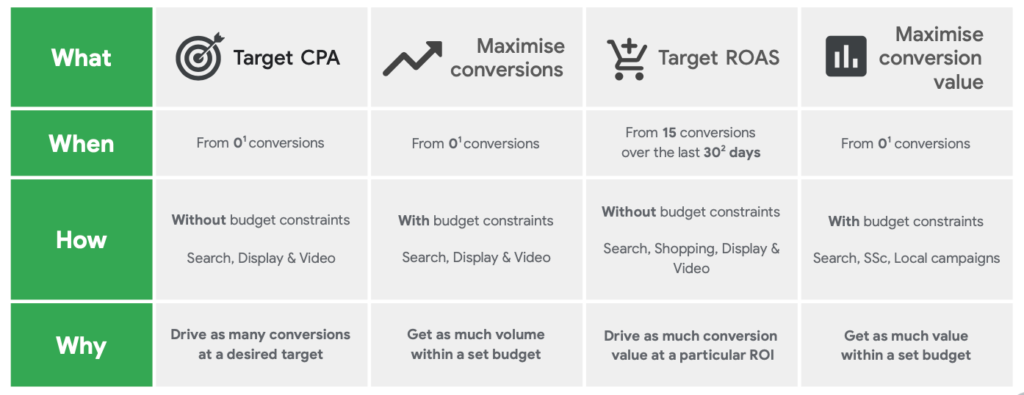
The current Smart Bidding strategies are:
At first glance, it may not seem like any of these fit the goals of a particular client, but it’s all about what you call a conversion. When you set up your conversion goals, make sure you match them with client goals. For instance, if your client only wanted more traffic to a specific product or service page, you could use a pageview goal potentially combined with a time on site metric, and a Maximize Conversions strategy. Or, you could use Maximize Clicks to get more traffic.
Have you tried automated bidding in the past without a great outcome? Don’t let a past experience taint your views on what it can do now. Automated bidding has (thankfully) changed a lot since the beginning, and it offers a valuable way to scale and improve your campaigns now.
At the start it was a bit like an unruly toddler but we suggest giving it another try now that it’s well-tested, more advanced and post-puberty! Some tips for success are:
As with everything, of course, you should perform testing. Don’t just convert everything over to Automated Bidding all at once ????. (We love your enthusiasm, but that’s a recipe for mediocre results at best and a disaster at worst.)
Gone are the days of needing a specific number of conversions just to deploy a bidding strategy. It is true that you’ll need 15 conversions over the last 30 days to start using tROAS or 20 conversions in 45 days for Shopping campaigns, however other strategies don’t have these requirements. In fact, they’ll help you scale your campaigns and increase your conversions if implemented properly.
Just one thing to note. The above doesn’t apply for video campaigns. For these, you’ll need at least 35 conversions per week to use an automated bidding strategy. That’s not to say that you can’t use one in your campaigns, but if you do it’s unlikely that you’ll be happy with the results ????????♀️.
First of all, wait…what? Why wouldn’t you use conversion tracking? Ok, well, that’s a topic that could take up a whole post by itself. Let’s say that it’s reasonable not to track conversions on your site. You can still use Maximize Clicks to improve your performance.
Bidding strategies fit all stages of the funnel. For the top of the funnel, you can use Maximize Clicks to get clicks to your site or Maximize Conversions and track page views of a key page, like the contact page. For an e-commerce, you can use this to track product page views.
Alternatively, if your goal is brand awareness, Target Impression Share is the strategy to use. You can choose the level of impression share you’d like to aim for, meaning you can chase a percentage of the total top of page results, absolute top of results page, or anywhere on results page impressions.
In the middle of the funnel, Maximize Conversions comes into play again. For e-commerce, you can use it to optimize for “add to cart” or similar actions. For lead gen, there are many ways to go about optimizing here. One possible scenario is using Maximize Conversion value and assign a value to something like a white paper download.
At the bottom of the funnel, your smart bidding suite does a fantastic job helping you reach your goals (tROAS, tCPA, and in controlled situations, Max Conversions and Max Conv Value with no targets).
There are loads of reasons to add tracking. Firstly, why would you spend money without being able to see what you get for your money? Second, it’s difficult to optimize when you can’t measure the effects of your changes. If you’re looking for reasons to add conversion tracking, these top the list for us.
Do you feel that your account structure isn’t optimized for automated bidding? So long as your account follows best practices, there’s no specific structure required to use automated bidding.
Automated bidding works at all stages of the funnel, which means:
Whether you have one campaign or 50, automated bidding can generally help you.
We hope we’ve busted some of the biggest smart bidding myths, and convinced you to give Smart Bidding a try. It can certainly be a valuable tool in your arsenal.
Here are a few of the most important takeaways.
Keep in mind your competition is using it to get ahead, so it’s a smart (ALL puns intended) strategy to strategically deploy Automated Bidding to take full advantage of real-time bid adjustments and machine learning.
We love talking PPC and spend most of our time chatting with agencies, so if you have a question please do drop us a line!
Also, Adpulse comes with a 14-day free trial, and right now the first month is only $19.99/mth, so it’s a low-risk way to try it for yourself. Sign up now!